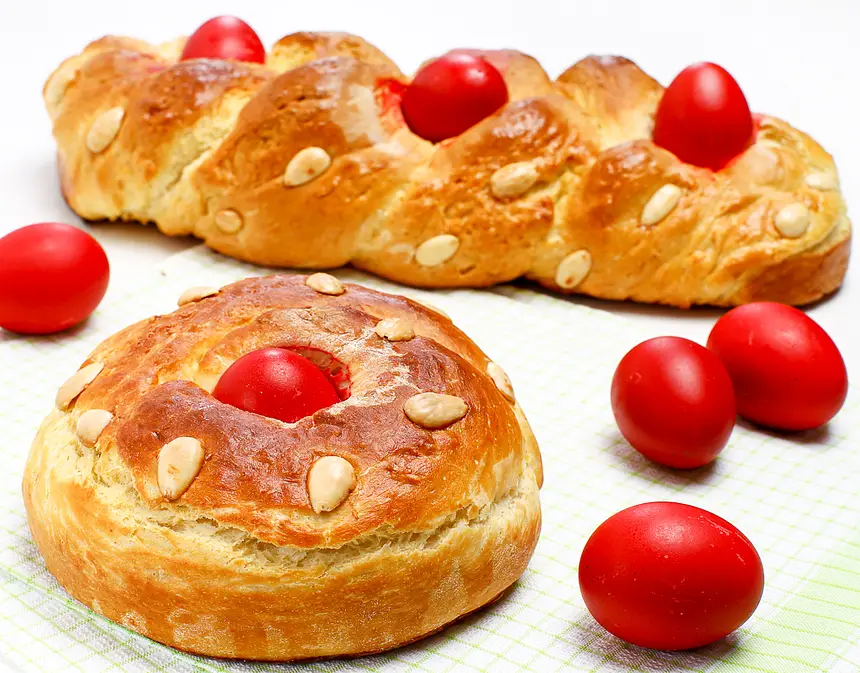
Greek Tsoureki (Easter Bread)


Submitted by josson
Braided Greek Easter bread enriched with butter, eggs, and fresh orange for a festive, aromatic loaf. The glossy orange-almond glaze creates a stunning, shiny chestnut finish perfect for holiday celebrations.
YIELD
36 servingsPREP
5 hrsCOOK
40 minREADY
6 hrsTsoureki is the crown jewel of Greek Easter baking.
This beautifully braided bread gets its signature flavor from fresh orange juice and zest kneaded right into the dough.
The rich, buttery crumb pulls apart in tender strands, while the orange-almond glaze brushed on during the final bake creates that iconic glossy, mahogany finish.
Traditionally, red-dyed hard-boiled eggs are tucked into the braid before baking, a symbol of renewal and rebirth.
Yes, it takes time (that double rise is essential), but the aroma filling your kitchen and the stunning centerpiece on your Easter table make every minute worthwhile.
Pro Tips
- Scald the milk properly: Heat until tiny bubbles form at edges, then cool before adding yeast
- Knead for 15 minutes: This develops the gluten for that signature tender, pull-apart texture
- Don’t skip the double rise: First rise (2-3 hours) and second rise (1½ hours) create proper structure
- Brush glaze twice: Once at 20 minutes, then return to oven for that rich, shiny finish
- Easter egg tradition: If adding dyed eggs, they’re decorative only and won’t be edible after baking
Ingredients
Directions
In a small saucepan, combine the milk and butter over medium heat and scald.
Stir until the butter melts, then pour into a mixing bowl.
When lukewarm, sprinkle in the yeast, and with fingers or a heavy spoon gradually stir in the ½ cup sugar until it dissolves.
Then add the salt, eggs 3 tablespoons of the orange juice, and the orange rind, stirring continuously, and gradually add half the flour until the mixture begins to bubble.
Continue adding flour gradually by hand; the dough will be sticky, but should not be stiff.
Flour your fingers lightly and knead for 15 minutes.
Place the dough in a large buttered bowl, brush the dough with melted butter, cover, and place in a warm area to rise until doubled in bulk (approximately 2 to 3 hours).
Punch the dough down and divide into 2 parts.
Divide each half into 3 parts and roll each into a long rope about 10 x 2 inches.
Braid the three ropes together; pinch to seal the ends if leaving long, or join together to form a long round loaf.
Repeat with the other half of the dough to make a second tsoureki.
Place in large baking pans or on a cookie sheet, cover, and let rise until doubled in bulk (approx.1½ hours).
Meanwhile, prepare the glaze by mixing the remaining orange juice, remaining sugar, and the almonds in a small bowl.
Bake the tsourekia in a 375 degree F oven for 20 minutes.
Remove from the oven and with a pastry brush glaze the tops and sides of loaves.
Return to the oven and bake for another 15 to 20 minutes until the color is a rich and shiny chestnut.
Note: If using the Easter eggs, tuck them into the center when you shape the loaves, leave until loaves have doubled and bake them with the loaf.
After baking, though lovely, the eggs will be inedible.

Comments


its peng