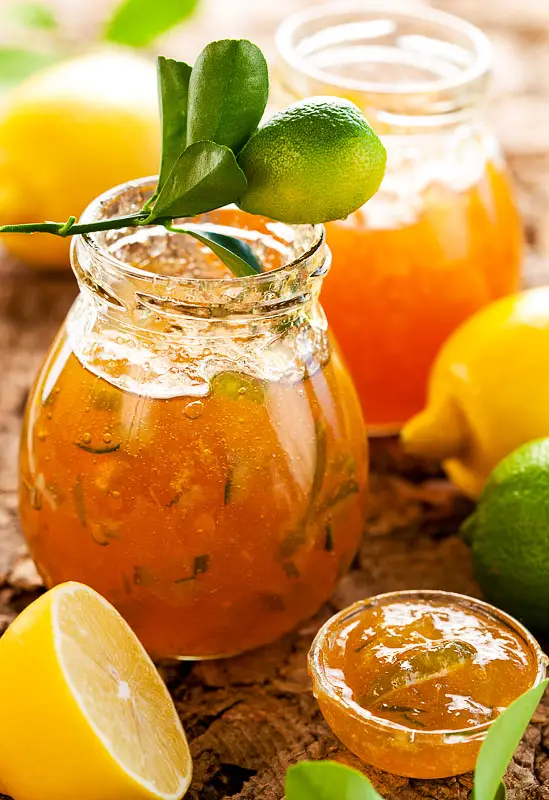
Rangpur Lime Marmalade


Submitted by suzette
Rangpur lime marmalade preserves whole rangpur limes and lemons in a small-batch sugar syrup over two overnight rests, sealed in jars with paraffin. Old-fashioned canning recipe.
YIELD
56 servingsPREP
30 minCOOK
40 minREADY
70 minRangpur lime marmalade is the small-batch preserve worth seeking out rangpur limes for. Despite the name, rangpurs are actually a mandarin-lemon hybrid that originated in India, producing an orange-red juice with intense sour-tangerine flavor unlike any other citrus. Combined with regular lemons and patiently cooked into marmalade, they yield a preserve with deep coral color and a flavor that’s both familiar and exotic.
The two-overnight-rest technique is what makes traditional marmalade work. The first overnight soak softens the chopped fruit and rinds, while the second rest after the initial boil allows the pectin in the rinds to disperse fully through the liquid, ensuring the marmalade sets properly during the final cook. Skip these rests and you end up with citrus syrup, not marmalade.
Cooking in small batches (4 to 6 cups of fruit at a time) is the canonical advice for reaching the proper gel point. Large batches don’t heat evenly to 222F (105C), and you’ll get either runny marmalade or scorched fruit on the bottom. The patience pays off in consistent set across all jars.
The sheeting test is the visual cue most experienced canners use. Two drops form on the edge of a cold spoon, slide together, and fall as one. That’s the moment to pull the pot from the heat.
The paraffin sealing method described here is an older preservation technique. Modern canners may prefer the standard water-bath canning method with proper two-piece lids for assured safety.
Pro Tips
- Pick rangpur limes when fully orange-red, green fruit is too sour and the color won’t develop
- Use a candy thermometer alongside the sheeting test, the two together confirm gel point
- Sterilize jars in boiling water for 10 minutes before filling, dirty jars spoil marmalade fast
- Label with the date, properly sealed marmalade keeps a year on a cool shelf
Variations
- Sub Meyer lemons or bitter Seville oranges for a more traditional marmalade
- Add a vanilla bean or split cinnamon stick during the final boil for warm flavor
- Spike with a tablespoon of whiskey or Cointreau at the end for an adult marmalade
Ingredients
Directions
Makes about 6 half-pints.
Wash and remove the seeds of the limes and lemons and put fruits through a food chopper or cut in small pieces.
Measure the pulp and add 3 cups of water for each cup of pulp; let stand overnight.
The next morning, boil the mixture, uncovered, in a preserving kettle about 20 minutes.
Remove mixture to a bowl, cover and let stand again overnight The next morning, measure citrus mixture.
Cooking batches of only 4 to 6 cups of fruit at a time, measure out ¾ cup of sugar for each cup of fruit and combine fruit and sugar in a preserving kettle.
Bring mixture slowly to a boil, stirring frequently until sugar has dissolved. Then boil rapidly for about 20 minutes until jellying point is reached.
Test for jellying point with a jelly thermometer which should read 200 to 222 F, or with a spoon which, when dipped into the mixture, has 2 drops form along the edge, come together and fall as 1 drop. Ladle into hot, sterilized jars and seal immediately.
To seal:
Fill to within ½-inch headroom, being sure to first wipe the rim and threads of the jars with a hot damp cloth to remove all particles of food, seeds or spices.
While contents are hot, cover with a ⅛ inch layer of paraffin.
When paraffin has set, add another layer of melted paraffin, tilting and rotating the jar to seal completely.

Comments



Please amend your site, it should read Parrafin WAX not parrafin.
Thanks for your comment. It is paraffin on the website, and it is the right spelling.