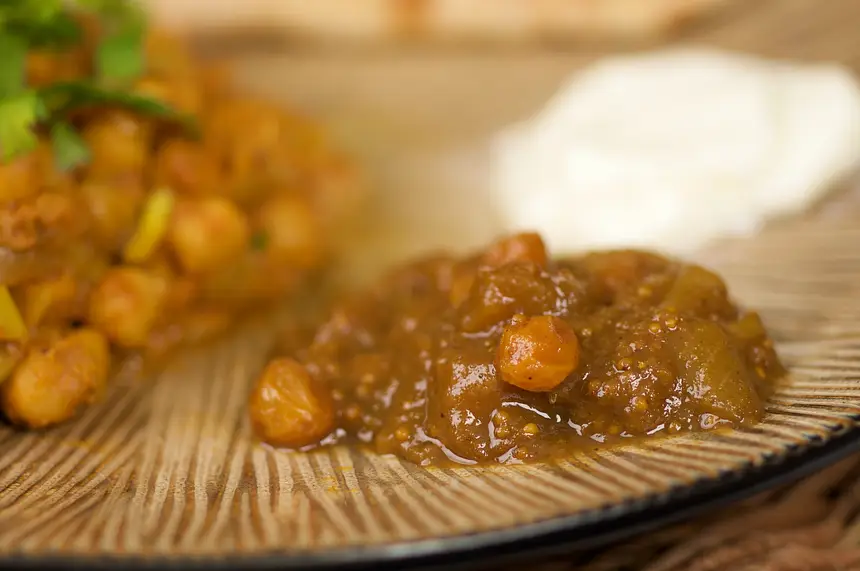
Mango & Tamarind Chutney


Submitted by nika
Mango and tamarind chutney: slow-simmered jammy preserve with mango, golden raisins, ginger, mustard seed, and sour tamarind. Water-bath canned for a year of shelf life.
YIELD
6 cupsPREP
30 minCOOK
3 hrsREADY
3 hrsHomemade mango chutney built on a tamarind base runs rings around any store-bought jar. The tamarind pulp soaks in warm water until it slumps into a tart, brown paste that brings the sour backbone this chutney is built around.
The mix of golden raisins and dried currants sneaks in sweetness and chew without making it cloying. Whole mustard seeds pop between your teeth and deliver bright peppery bursts between the slow-melted fruit.
You choose the texture. Small dice and part-ripe mango give you a jammy, spreadable finish. Larger half-inch cubes of unripe fruit stay chunky and bright, especially if you pull the pot the moment the flesh turns translucent.
A full month of jar-aging in a cool pantry is part of the process. The vinegar mellows, the spices bloom, and the flavors blur together into something far more complex than what comes out of the pot.
Kitchen Tips
- Press the soaking tamarind through a sieve hard and scrape the underside. That clinging paste carries most of the flavor.
- Stir constantly during the last 20 minutes of simmering. The sugar content is high and the bottom scorches in a blink.
- Leave a generous ¼ inch of headspace in the canning jars and process a full 15 minutes in a boiling water bath for a safe seal.
- Test a cooled spoonful before canning and adjust vinegar, sugar, or cayenne to taste. Hot chutney lies about its salt and sweet.
Variations
- Use peach or green mango alone for a regional take.
- Add a split vanilla bean or a star anise pod during the simmer for an aromatic lift.
- Stir in toasted slivered almonds or pistachios off the heat for texture contrast.
Ingredients
Directions
*Mangoes can be unripe, half-ripe or part unripe and part ripe.
Using part or all almost-ripe fruit will yield a chutney with a softer texture.
If you like jammy chutney, cut the fruit into small bits; for a chunky product, use ½ inch or larger cubes and stop cooking the mixture as soon as the fruit pieces are translucent.
**In place of the crushed dried red pepper, can substitute 2 dried hot peppers (each 2½ to 3 inches long) which have been seeded and crumbled, or 1 tb. finely minced red or green fresh hot peppers.
Increase any of these if you are sure you want a hotter chutney.
Crumble tamarind into a small bowl and stir in 2½ cups of the water; let tamarind soak for at least an hour, meanwhile preparing the remaining ingredients.
Or substitute the fresh lime juice plus ½ cup of water at this point.
Peel and dice the mangoes, cutting them into small pieces for a jamlike chutney, into ½ inch or larger dice for a chunky mixture.
Place the pieces in a preserving pan.
Add the onions, raisins, currants, ginger, garlic, lemon zest, brown and granulated sugars, mustard seed, salt, crushed hot red pepper, cinnamon, turmeric, cloves, ground red pepper, white vinegar and the remaining 1 cup water; stir the mixture and let it rest until the tamarind juice is ready, or for up to several hours, if that is convenient.
When the tamarind pulp is very soft, strain the liquid through a sieve, pressing it to remove all possible liquid and any pulp that will pass through.
Discard the pulp remaining in the sieve.
Add the liquid to the chutney mixture.
Set the pan over medium heat and bring the ingredients to a boil.
Lower the heat so the mixture simmers and cook it, uncovered, stirring often, until the mango and onion pieces are translucent and the chutney has thickened to the consistency of preserves, 1 to 2 hours depending on the firmness of the fruit.
(The chutney will thicken further in the jar, so don’t reduce it too much.)
If the chutney threatens to stick before the mango pieces are translucent, add a little water.
Remove chutney from the heat, cool a sample, and taste it for tartness, sweetness, and degree of hotness.
(The overall flavor is elusive at this point, but these factors can be judged.)
If you wish, add a little more vinegar, sugar or ground hot red pepper.
Reheat the chutney to boiling and ladle it into hot, clean pint or half-pint canning jars, leaving ¼ inch of headspace.
Seal the jars; process for 15 minutes (for either size jar) in a boiling-water bath.
Cool, label, and store the jars for a least a month so that its many flavors can blend and balance.
This will keep for at least a year in a cool pantry.

Comments


Sounds really good.